
Visiting the Sick as a Parish Ministry
A Prayer That Fits Anywhere
Few prayers travel as well as the rosary. It folds into a coat pocket, needs no book, and can be prayed on a bus, in a hospital waiting room, on a walk through the park, or in the last quiet minutes before sleep. Here in our Cheadle parish you will find it said before weekday Mass, in the homes of families who gather after tea, and in the stillness of Adoration. The rosary is not a magic formula or a measure of holiness; it is a school of prayer, and like any school it rewards patience and repetition. A child learning the Hail Mary and a parishioner who has prayed it for eighty years are both welcome in the same classroom.
How the Rosary Is Prayed
The rosary is built around a crucifix and a string of beads. Praying a full rosary means five decades, and each decade is a doorway into a moment in the life of Christ or his Mother.
- Opening: the Sign of the Cross, the Apostles' Creed, the Our Father, three Hail Marys for faith, hope and love, and the Glory Be.
- Each decade: announce the mystery, pray the Our Father, ten Hail Marys, then the Glory Be. Many parishes also add the Fatima prayer: "O my Jesus, forgive us our sins..."
- Closing: the Hail Holy Queen, and the Sign of the Cross.
The larger beads mark the start of each decade; the ten smaller ones carry the Hail Marys. Speed is not the point. If your attention wanders halfway through a decade — and it will — simply return to the mystery and carry on. Some people keep a picture or a line of Scripture in front of them; others hold one short phrase, such as "Jesus is born in Bethlehem", as an anchor for the ten prayers.
The Joyful Mysteries
Traditionally prayed on Mondays and Saturdays, and on the Sundays of Advent and Christmas, the joyful mysteries follow the hidden life of the Holy Family in Nazareth.
- The Annunciation
- The Visitation
- The Nativity
- The Presentation of Jesus in the Temple
- The Finding of the Child Jesus in the Temple
These mysteries are wonderfully ordinary. They speak of a young woman saying yes to God, of a cousin's kindness, of a birth in poor surroundings, and of parents anxious about a missing child. They teach trust and patience, and they are a good place for anyone beginning again, or for families praying together with small children.
The Sorrowful Mysteries
Prayed on Tuesdays and Fridays, and on the Sundays of Lent, these mysteries draw us into the Passion. In Lent our parishes often pair them with the Stations of the Cross.
- The Agony in the Garden
- The Scourging at the Pillar
- The Crowning with Thorns
- The Carrying of the Cross
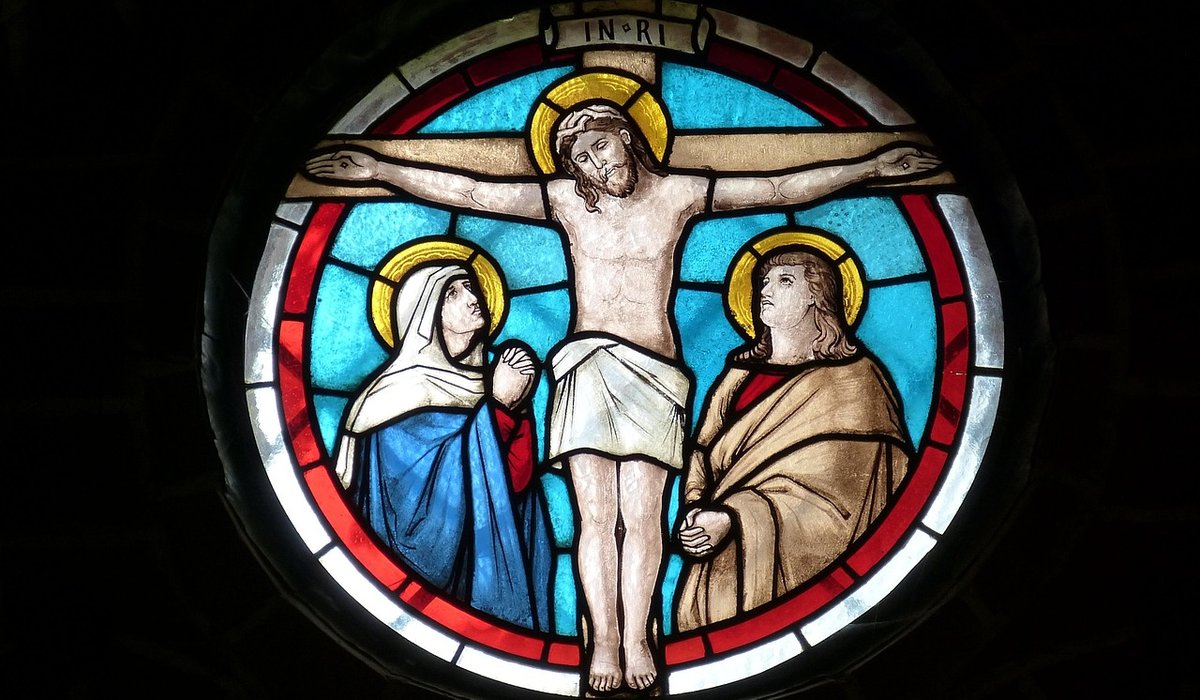
- The Crucifixion and Death of Our Lord
They are not gloomy for their own sake. They give us language for our own suffering and a place to lay the sorrows of others — the sick, the dying, the lonely, those carrying burdens they cannot name. A decade prayed slowly at a hospital bedside can say more than many words.
The Glorious Mysteries
Prayed on Wednesdays and Sundays, the glorious mysteries lift our eyes to the promises that sustain the whole Christian life.
- The Resurrection
- The Ascension
- The Descent of the Holy Spirit
- The Assumption of Our Lady
- The Coronation of Our Lady
Here the rosary answers the sorrow of the previous set. The Resurrection is the Church's firm hope that death does not have the last word, and the Assumption reminds us that Mary's destiny is the destiny promised to all the faithful. During November, many parishioners pray these mysteries for their own dead by name.
The Luminous Mysteries
Prayed on Thursdays, the luminous mysteries were added by Pope John Paul II in 2002. They fill the gap between the hidden life and the Passion, and they sit naturally alongside the Church's Thursday focus on the Eucharist.
- The Baptism of Jesus in the Jordan
- The Wedding at Cana
- The Proclamation of the Kingdom of God
- The Transfiguration
- The Institution of the Eucharist
If you keep an hour of Adoration in the parish, these are the mysteries to bring with you. Thursday is also a good day for those preparing children for First Holy Communion: the fifth mystery is the very gift they are preparing to receive.
You do not need to pray a whole rosary to begin. One decade in the car on the way to work, one decade before the Blessed Sacrament, one decade with a neighbour who is unwell — this is how the rosary quietly takes root in a life. Over the coming week, why not choose a fixed time each day, decide which set of mysteries fits that day, and let Our Lady do the rest.
LEAVE A COMMENT